Lakshmana was the twin brother of Shatrughna. He was born in Ayodhya. Rama was the eldest son of Daharatha, Bharata was the second, Lakshmana was the third and Shatrughna was the youngest of all four brothers. Though Lakshmana was twin to Shatrughna, he was specially attached to Rama. The duo of Rama and Lakshmana are inseparable. When Rama was married to Sita, the daughter of King Janaka of Mithila, Lakshmana married Sita`s younger sister Urmila.
In the Puranic scriptures Lakshmana is ascribed as the incarnation of Ananta Sesha, the thousand-headed Naga. Lord Vishnu rests upon the Ananta Sesha in the primordial ocean of milk (Kshirasagara). Seshanaga was the Lord of Serpents, who was incarnated in the earth in the form of Lakshmana in `Treta` yuga. In `Dwapara` Yuga, Seshanaga incarnated as Balarama. Seshanaga is considered as eternal incarnation to give company to Lord Vishnu in all his Avatara.
 Lakshmana was `the perfect man` or `Mariyada Purushottam` personified by Rama. He was the symbol of loyalty, love and commitment to his elder brother who shared all the moments of his joy and sorrow equally with him. Lakshmana was an unbeatable warrior committed to virtue and the service to his elder brother. He never thought twice while joining his brother Rama in exile though he was not asked by anybody to do so, nor he coveted the throne of Ayodhya.
In the earlier part of exile when Bharata enters the forest with a large entourage to persuade Rama to return to Ayodhya, Lakshmana made mistakes by jumping to the conclusion that Bharata had some malicious intention. However Rama knew Bharata`s original desire and he pacified Lakshmana by saying that Baharata never would harm them.
Lakshmana served Rama and Sita during their exile with great reverence and devotion. Lakshmana made home for Rama and Sita, guarded them at night, used to bring food for them and accompanied them in long tiring journeys and the lonely life of forest. All he did without complaining or cares for himself.
The king of demons, Ravana planned to kidnap Sita. He sent a magical golden deer for her, which was none but magician demon Maricha, who had the motto to distract Rama and Lakshmana away from the hut so that Ravana could kidnap Sita without any hindrances. Rama went after the golden deer but sensed bad omens, danger and evil. So he asked Lakshmana to guard Sita at their home.
When Rama killed the deer, the mysterious demon Maricha cries out imitating Rama`s voice and called Sita and Lakshmana for help. Although Lakshmana knew that Rama was unvanquishable and beyond any danger but he had to go as Sita was in panic and urged Lakshmana to go to help Rama immediately. Lakshmana was unable to overcome the order of frightened Sita and had to go to search Rama. Lakshmana however used his mystical power to draw the Lakshmana Rekha or Lakshman`s limit, a perimeter line across the hut and asked Sita not to cross it. Any unwanted invader who crossed it would be killed instantly and thus the Lakshmana Rekha would serve for Sita`s safety.
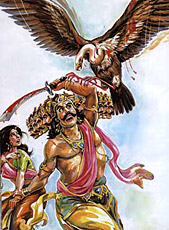 When Lakshmana was gone, Ravana came in the guise of a mendicant Brahmin and asked for alms. Sita crossed the Lakshmana Rekha out of compassion to give alms to the mendicant. Thus, Ravana was able to seize Sita safely.
Rama and Lakshmana came back to the empty hut. They went out in search of Sita. Rama and Lakshmana found Sita`s jewellery as she threw it from the aerial chariot of Ravana, the Pushpakaratha. Rama asked lakshmana for verification whether he could recognize Sita`s jewellery but Lakshmana could only recognize her feet-adornment, as he never looked at the face of Sita. However finally Rama and Lakshmana was able to know who he had stolen Sita. They made friendship with Sugriva and Hanuman and set towards Lanka. Sugriva`s monkey army assisted Rama.
Rama and Lakshmana had a great fight with Ravana and his demon battalion. Lakshmana was a powerful warrior and he slew thousands of Rakshas including Atikaya and Prahasta, ravana`s chief commanders and also his son Indrajit. Lakshmana aided Rama in killing the great giant Kumbhakarna.
During the great battle to rescue Sita, a mystical weapon fired by Ravana`s son Indrajit fatally injured Lakshmana. Lakshmana felt unconscious. The vanara (monkey) physician explained that only special herb called Sanjivani could save Lakshmana`s life. Hanuman set his journey to Dronagiri Mountain, where Sanjivani was found. But after reaching there he was unable to identify the herb and brought the entire mountain instead to the battlefield. The magical herb was finally retrieved and Lakshmana was revived.
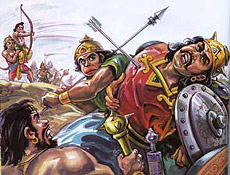 Later in the battle Lakshmana fought and killed Indrajit. Lakshmana used an unorthodox means to kill Indrajit, which was considered as a turning point of the battle. Indrajit was considered unbeatable as the king of gods, Indra supported him.
Lakshmana disobeyed Rama only once during the lifetime. Rudra, the god of time came to meet Rama. Before they started their conversation, Rudra asked for uninterrupted privacy. Rama realized that it was a difficult task to prevent anybody from entering the room and so he asked Lakshmaan to guard the door of the room. In the meantime when Lakshmana was standing as a guard the angry sage Durvasa came and wanted to meet Rama. Lakshmana politely asked him to wait for a while until the conversation was complete. Durvasa felt humiliated and was about to curse that would destroy Rama, Lakshmana and the city of Ayodhya at once. Lakshmana thought it would be better to enter the room than to have the sage`s curse. Thus only once he disobeyed Rama`s order for the sake of other`s well-being.
Lakshmana is revered for his absolute devotion and surrender to Rama. As a yonger brother he always served his elder brother Rama with a great sacrifice in all adverse condition. The life of Lakshmana is an example of self-sacrifice, duties of man to his elders and superiors and teaches the value of selflessness.

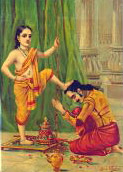 Lord Vishnu came to rescue the world from Bali`s torture. He appeared as his `avatar` or consort of Vamana or a dwarf Brahmin boy. The boy asked for land from King Bali. Bali asked that how much land he needs. The Boy answered that only three steps of land would be enough for him. Bali smiled and granted his prayer. The Vamana covered the whole earth with his first step, put his second step into the sky and wanted to know from Bali Raja where he should keep his third step. Bali realized who this boy was and offered his head so that Vamana could put his third step there. Thus Vishnu saved the world.
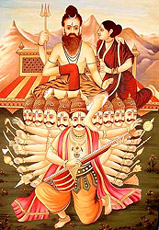 Though Ravana had an aggressive and arrogant nature, he was an exemplary scholar. Ravana mastered Vedas and other holy scripts under the care of his father Vishrava. He also learnt the art and techniques of Kshatriya life. Sumali, his maternal grandfather put a watch on him so that Ravana retained the ethics of Daityas.