In ancient India, Janaka was king of Mithila and the father of Sita, the beautiful central character of Ramayana. Janaka was remarkable for his great knowledge, good works and sanctity. Janaka is also known as Siradhwaja(one, who is plough banner). When king Janaka was ploughing the ground and preparing for a sacrifice to have offspring, Sita sprang up from the furrow and thus he got a child.
When Sita grew up, Janaka arranged a Swayambhara, where he proposed a test of strength to string the great bow of Shiva called `Haradhanu`. He decided that one, who will be able to do it, would be able to have Sita`s hand. Lord Rama passed the test and was married to Sita. Janaka had three other daughters namely Mandavi, Urmila and Shrutakirthi who were married to three brothers of Rama, Bharat, Lakshman and Shatrughna respectively.
Janaka was a brave king as well and was versed in all the Shastras and Vedas like a sage or Rishi. Janaka was the dearest student of Yaajnavakya, who was also a wise person. In Bhagavad Gita Srikrishna cites Janaka as an example of Karma Yoga.
King Janaka was also known as `Rajarshi` as he was a Raja (king ) and Rishi (sage) at the same time. He administered the kingdom of Mithila (Videha) and at the same time he attained the spiritual advanced state of a Rishi. Sage Ashtavakra instructed Janaka about the nature of `Atman`(self).This instruction together are written in the famous treatise of `Astavakra Gita`.
Wednesday, August 5, 2009

Indrajit
Indrajit or Meghnaada is a great warrior of Ramayana, who was son of Ravana, the king of Lanka and Mandodari, daughter of Mayasura. Indrajit was such a courageous warrior that he could rival Rama with a great fighting skill. Indrajit was an ideal son and citizen.
Indrajit was named as Meghnaada at his birth because when the child cried for the first time, thunder and lightening resounded, signifying the birth of a great warrior. Lord Brahma conferred his cognomen Indrajit upon him when he defeated and imprisoned Indra, the king of gods. Indrajit was neither a deva (god), nor a bhakta (devotee) but still he was so renowned because of his courage and efficiency in battle. Though Indrajit was a rakshasa, still his respect for his father Ravana paralleled Rama`s devotion to his father Dasaratha. Indrajit realized that Lakshman was the incarnation of a divine being and it was not easy to defeat him, still he chose to fight him till the end according to his father`s wish rather than selecting a disgrace of leaving the battle.
Indrajit was married to Sulochana (also known as Prameela). Prameela came from the nagas and was daughter of Adishesha, who was the incarnation of Lakshmana according to some sects.
 When Indrajit got his victory over Indra, he was granted with a Brahmastra. It is believed that Brahmastra was a great weapon having tremendous power and when it left the bow it could beat any arrow and kill any person at wish.
Indrajit took a significant role in the Great War between Rama and Ravana. He had access to all the divine weapons like Brahmastra, Pashupatastra etc. Indrajit even bound Rama and Lakshman under the `Nagpash` (serpent spell). The king of birds Garuda subsequently freed Rama and Lakshman from the Nagpash by killing the serpents.
Indrajit was unbeatable in any war as he carried out Yajna(sacrifice) before any battle, and could only be killed by enemy force who destroyed the Yajna. Lakshman attacked the Yajna with the help of Sugreeva and successfully destroyed it. Indrajit came out of the temple and had a terrible battle with Lakshman. He shot Brahmastrato kill Lakshman but the missile denied to kill him. He shot Pashupatastra, which Shiva bestowed him but it also denied to kill his enemy.
Finally Indrajit used the most powerful missile of the three worlds to slay Lakshman but it was also unsuccessful. After that Indrajit knew that it would be difficult to defeat Lakshman and used his magical power to transport himself to his father Ravana`s palace. He tried to pursue Ravana once again to bow before Rama and adapt the side of truth but Ravana was stubborn at his resolve and Indrajit`s efforts were all in vain. Indrajit then said goodbye to his mother Mandodari and his wife Sulochana for the last time.
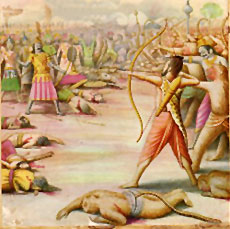
Finally Indrajit returned to the battlefield. Frightful war started between Indrajit and Lakshman and Lakshman pierced Indrajit`s neck with his arrows, which caused his death. The army of Rama was overjoyed with the success and wanted to celebrate the victory by desecrating Indrajit`s body. But Rama was a virtuous man and adhered to his `Dharma`. Rama said that Indrajit was his enemy when he was alive but now that He is dead he is no more their enemy. Rama took off his shawl and covered the body of the slain warrior and asked Hanuman to carry the body to the main entrance of Lanka so that royal family could carry out the funeral process of Indrajit.
Indrajit was named as Meghnaada at his birth because when the child cried for the first time, thunder and lightening resounded, signifying the birth of a great warrior. Lord Brahma conferred his cognomen Indrajit upon him when he defeated and imprisoned Indra, the king of gods. Indrajit was neither a deva (god), nor a bhakta (devotee) but still he was so renowned because of his courage and efficiency in battle. Though Indrajit was a rakshasa, still his respect for his father Ravana paralleled Rama`s devotion to his father Dasaratha. Indrajit realized that Lakshman was the incarnation of a divine being and it was not easy to defeat him, still he chose to fight him till the end according to his father`s wish rather than selecting a disgrace of leaving the battle.
Indrajit was married to Sulochana (also known as Prameela). Prameela came from the nagas and was daughter of Adishesha, who was the incarnation of Lakshmana according to some sects.
When Indrajit got his victory over Indra, he was granted with a Brahmastra. It is believed that Brahmastra was a great weapon having tremendous power and when it left the bow it could beat any arrow and kill any person at wish.Indrajit took a significant role in the Great War between Rama and Ravana. He had access to all the divine weapons like Brahmastra, Pashupatastra etc. Indrajit even bound Rama and Lakshman under the `Nagpash` (serpent spell). The king of birds Garuda subsequently freed Rama and Lakshman from the Nagpash by killing the serpents.
Indrajit was unbeatable in any war as he carried out Yajna(sacrifice) before any battle, and could only be killed by enemy force who destroyed the Yajna. Lakshman attacked the Yajna with the help of Sugreeva and successfully destroyed it. Indrajit came out of the temple and had a terrible battle with Lakshman. He shot Brahmastrato kill Lakshman but the missile denied to kill him. He shot Pashupatastra, which Shiva bestowed him but it also denied to kill his enemy.
Finally Indrajit used the most powerful missile of the three worlds to slay Lakshman but it was also unsuccessful. After that Indrajit knew that it would be difficult to defeat Lakshman and used his magical power to transport himself to his father Ravana`s palace. He tried to pursue Ravana once again to bow before Rama and adapt the side of truth but Ravana was stubborn at his resolve and Indrajit`s efforts were all in vain. Indrajit then said goodbye to his mother Mandodari and his wife Sulochana for the last time.
Finally Indrajit returned to the battlefield. Frightful war started between Indrajit and Lakshman and Lakshman pierced Indrajit`s neck with his arrows, which caused his death. The army of Rama was overjoyed with the success and wanted to celebrate the victory by desecrating Indrajit`s body. But Rama was a virtuous man and adhered to his `Dharma`. Rama said that Indrajit was his enemy when he was alive but now that He is dead he is no more their enemy. Rama took off his shawl and covered the body of the slain warrior and asked Hanuman to carry the body to the main entrance of Lanka so that royal family could carry out the funeral process of Indrajit.
Angada
Angada was a great Vanara (monkey) in the Hindu epic Ramayana, who helped Rama to search his wife Sita along with Sugriva and other monkeys. Angada was the son of monkey king Vali and his wife Tara. He was the nephew as well as stepson of Sugriva.
Vali at the time of his death requested Sugriva to take care of his son Angada and to protect him everyway, as Sugriva would have done in case of his own son. Vali stated that Angada was dearer than life to him and asked Sugriva to be his refuge in dangers and father, donor and protector to him.
Sugriva consecrated Angada as the prince of Kiskindhya and groomed him in such a manner that he was able to successfully execute any duty of higher responsibility. When Vanara task was formed for the search of Sita, Angada was assigned the post of assistant to Nila, one of the senior most deputies of Sugriva. Sugriva ordered Angada to approach the senior monkeys with his command. Sugriva made Angada the assistant of Nila to accomplish his training under an able hand. Once the youngster Angada learnt the intricate details of his job he was assigned with a more important duty that was heavy for a Vanara of his age. He was given the task to find Sita in every possible places of South India, as it was known that Sita was hidden in some place of South, either in mainland or in the island. Angada scoured every city of South up to the seashore, Rameshwaram, to fulfill his duty. When the battalion was formed to proceed further south, Angada was made the head of the team.
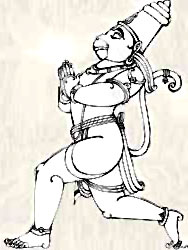 Angada led the Vanara team comprising of senior monkeys like Hanuman, Jambavan very efficiently. As a prince, Angada got loyalty and respect from other monkeys. But in some cases Vanaras gave in under stress and angada charged them up as the part of his duty.
When Sita was found in Lanka, Rama wanted to find out some peaceful solution of rescuing Sita and averting the war. The messengers sent to Ravana were again led by Angada. Angada explained Ravana what was Rama`s desire and said that if he released Sita the war could be avoided. Angada tried by every means to convince Ravana, but Ravana was firm at his resolution to face a battle instead of returning Sita peacefully.
At one point of the conversation Angada placed his foot firmly on the ground and threw a challenge that if anybody in the Ravana`s court was able to uproot his foot Rama would lose the battle and return without Sita. All the Rakshasa courtier of Ravana`s army and even his son Indrajit tried to lift Angada`s left foot but nobody succeeded. Ravana was angered as he felt humiliated and started insulting Rama with abusive words.
Angada was so furious that he hit the ground with enormous force with both his hands and it caused a minor tremor in earth. All the courtiers were frightened and flew away. Ravana fell down from his throne and his crowns rolled off from his heads. Before he could put them back on his heads Angada grabbed four of those and threw them towards the direction where rama was waiting with his brother Lakshmana. When Vanaras saw the flying crowns approaching them they got panicked. But Rama knew that those were crowns of Ravana. Hanuman caught the flying crowns and placed them in front of Rama.
Ravana ordered his men to catch and kill Angada but he laughed aloud and escaped. In the great war of Ramayana, Angada killed Ravana`s son Devantak.
Vali at the time of his death requested Sugriva to take care of his son Angada and to protect him everyway, as Sugriva would have done in case of his own son. Vali stated that Angada was dearer than life to him and asked Sugriva to be his refuge in dangers and father, donor and protector to him.
Sugriva consecrated Angada as the prince of Kiskindhya and groomed him in such a manner that he was able to successfully execute any duty of higher responsibility. When Vanara task was formed for the search of Sita, Angada was assigned the post of assistant to Nila, one of the senior most deputies of Sugriva. Sugriva ordered Angada to approach the senior monkeys with his command. Sugriva made Angada the assistant of Nila to accomplish his training under an able hand. Once the youngster Angada learnt the intricate details of his job he was assigned with a more important duty that was heavy for a Vanara of his age. He was given the task to find Sita in every possible places of South India, as it was known that Sita was hidden in some place of South, either in mainland or in the island. Angada scoured every city of South up to the seashore, Rameshwaram, to fulfill his duty. When the battalion was formed to proceed further south, Angada was made the head of the team.
Angada led the Vanara team comprising of senior monkeys like Hanuman, Jambavan very efficiently. As a prince, Angada got loyalty and respect from other monkeys. But in some cases Vanaras gave in under stress and angada charged them up as the part of his duty.When Sita was found in Lanka, Rama wanted to find out some peaceful solution of rescuing Sita and averting the war. The messengers sent to Ravana were again led by Angada. Angada explained Ravana what was Rama`s desire and said that if he released Sita the war could be avoided. Angada tried by every means to convince Ravana, but Ravana was firm at his resolution to face a battle instead of returning Sita peacefully.
At one point of the conversation Angada placed his foot firmly on the ground and threw a challenge that if anybody in the Ravana`s court was able to uproot his foot Rama would lose the battle and return without Sita. All the Rakshasa courtier of Ravana`s army and even his son Indrajit tried to lift Angada`s left foot but nobody succeeded. Ravana was angered as he felt humiliated and started insulting Rama with abusive words.
Angada was so furious that he hit the ground with enormous force with both his hands and it caused a minor tremor in earth. All the courtiers were frightened and flew away. Ravana fell down from his throne and his crowns rolled off from his heads. Before he could put them back on his heads Angada grabbed four of those and threw them towards the direction where rama was waiting with his brother Lakshmana. When Vanaras saw the flying crowns approaching them they got panicked. But Rama knew that those were crowns of Ravana. Hanuman caught the flying crowns and placed them in front of Rama.
Ravana ordered his men to catch and kill Angada but he laughed aloud and escaped. In the great war of Ramayana, Angada killed Ravana`s son Devantak.
Subscribe to:
Posts (Atom)